Saturday, June 19, 2010

San Diego Temple

On the way back from La Jolla, we drove a little out of the way so we could see the temple.


You can imagine how surprised we were to see it looking like this!

June 19, 2010 Dives - La Jolla Shores

On Saturday, June 19, 2010, the plan was to do two dives at La Jolla Shores.

While George Robison, Ken Patrick and I were gearing up, the first buddy team went out to start their first dive. They never made it through the surf! One especially powerful wave hit them as they were nearly out and snapped the tank band on one diver's BCD. They almost lost the tank, but Will managed to grab it and assist them back to shore. They decided not to attempt it again.

We were nearly ready, but another team went first, so we decided to watch and see how they did. They made it all the way through the breakers and we thought they were good to go. The next thing we knew they were walking back through the surf and being assisted by Will and Mark.

Just then another group of divers from a local club came back from an earlier dive and suggested to us that we not bother. The viz in the trench was about 2 feet, so they had come back up onto the shelf and attempted to do a free descent and everyone lost his buddy due to poor viz.

I called the dive for our group since I was not going to take George out in that. That was the end for our whole group. Everyone bailed when I did.

Friday, June 18, 2010

June 18, 2010 Dives - La Jolla Cove

On Friday, June 18, 2010, I dove with Ken Patrick and George Robison. We did two dives at La Jolla Cove.

Today was the second sunny day of the trip. I was the Divemaster again for our group since they both seem to rely on me to lead them. I briefed Ken and George on what we would do. We decided to dive along the west edge of the Cove near where a bunch of sea lions were sunning on the rocks.

The first dive, we were really shallow throughout the dive, only 17 feet for maximum depth. The visibility was awful - 5-10 feet. I took a couple of photos of lobsters and Garibaldi, but nothing much else before the drama struck.

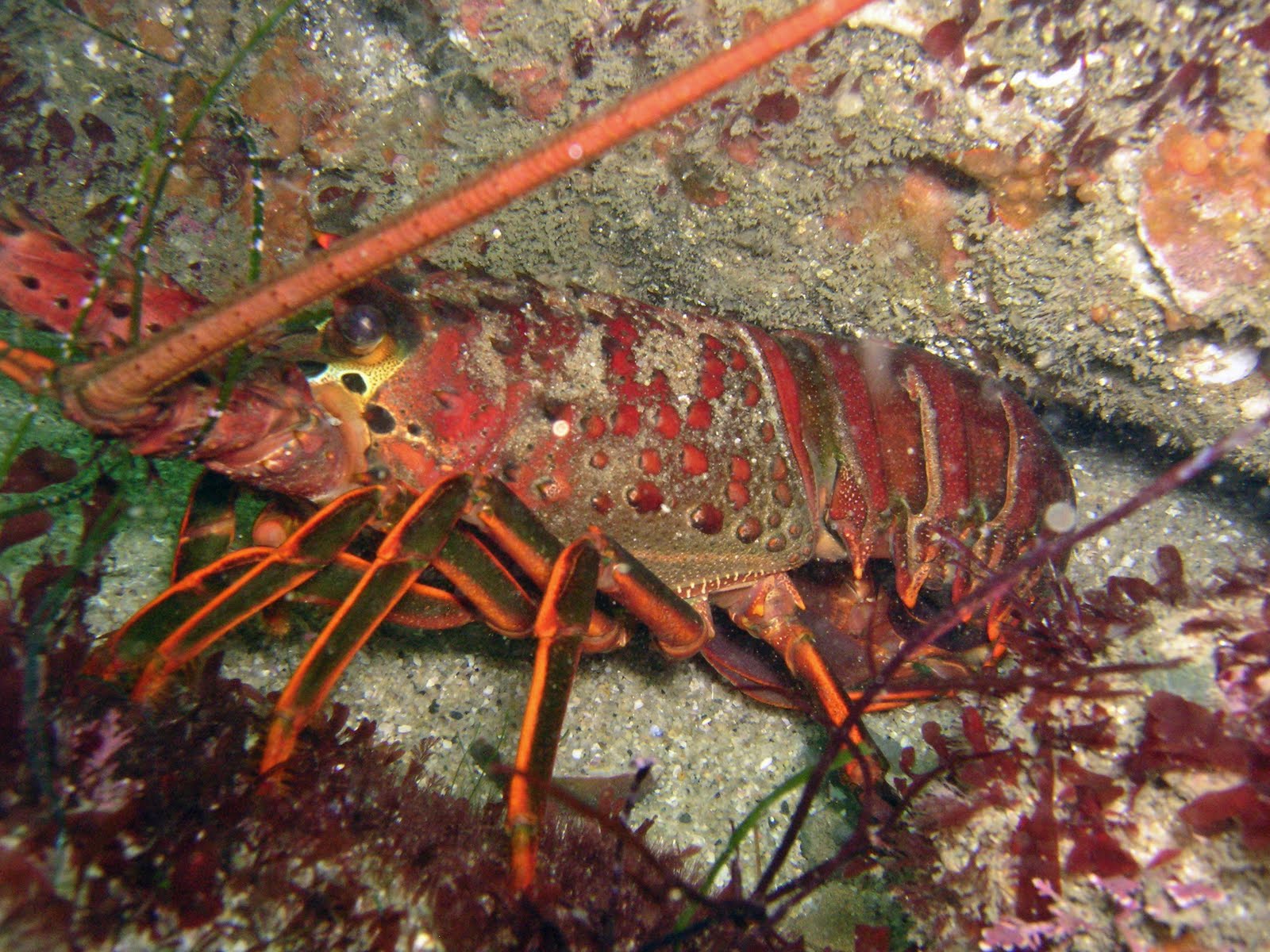
California Spiny Lobster

I told them to let me know when they got to 1800 psi. Apparently, George misunderstood me and thought we would turn around at 1800, so when I did not move immediately to turn around, he bolted for the beach.

I was afraid he actually would run out of air, so I followed along and Ken followed me. He went right into the rocks and then back into the Cove right by the sea lions. When a couple of them slipped into the water near him, he checked his air and discovered he still had 1500 psi and decided it would be alright to dive a little more.

While he was trying to take a photo of a sea lion, he got a little too close and it really snapped its jaws at him. He went into reverse and was really making tracks backwards to get away at that point. He chased Garibaldi all the way back to the beach trying to get a photo. I was at the surface just swimming along behind him to keep an eye on him. When we got to the beach, he still had 1000 psi and Ken and I had 2000.

I gave him some advice that he needs to learn to trust those who have more experience until he gains enough of his own to know that he will be OK. At that point, we all got out and were done with that dive.

After a fairly long surface interval, we went back for the second dive. Gordy joined us and offered to be George's buddy. I accepted. After getting into the water and finally getting George's fins on him, I told them to put snorkels in and swim out with me a ways. We swam out a couple of hundred yards and then I stopped. I told them, for George's sake mostly, that we got clear out to where we were without using any air. They should end their dive with 500 psi, but they could end it anywhere they were and did not have to be back on the beach. With 500 psi, they could surface, establish positive buoyancy and then make the surface swim back to shore.

Gordy took off like a shot and George went with him. Ken and I soon lost them in the poor visibility which left us to do our own thing. That was nice, actually. We enjoyed a long, relaxing dive and saw lots of "bugs" - lobsters. The visibility was still really poor, but we had a good time and Ken gained more confidence in his diving as well.

Garibaldi


California Spiny Lobster


California Spiny Lobster


California Spiny Lobster


California Spiny Lobster

Thursday, June 17, 2010

June 17, 2010 Dives - Yukon and NOSC Tower

On Thursday, June 17, 2010, I dove with Dewey Olsen and Ken Patrick. Ken's buddy George Robison was getting his Deep Diver certification today, so he dove with Will. We did two dives on the Yukon, a 105 foot deep dive on a Canadian Navy Destroyer that was intentionally sunk as an artificial reef and one dive on the NOSC Tower, a 60 foot deep dive on a sunken weather tower.

The Yukon is a 366 foot long ship. Nearly twice the length of the Mahi. It is a really large wreck. It went down a little prematurely when they were preparing it for sinking and it rolled and landed on its port side, so the top surface is actually the starboard side.

Today was the first time that we had sunshine for the entire trip. Once again, I was the Divemaster for our group. I briefed Dewey and Ken on what we would do. We were tied off to the observation tower just forward of the aft gun turret. This was the first time either of them had been below 60 feet. They were just happy to follow along and get to see this first-hand. We dropped down the mooring line to the tower and then on down to the bottom. Maximum depth for the dive was 96 feet and minimum temperature was 48 degrees. It was frigid even in a 7 mil wetsuit with my hooded vest. I was glad we were as limited on time due to depth as we were.

We checked out the aft gun turret and then swam slowly to the stern of the ship. I tried to take a few photos of the Plumose Anemones and other interesting things, but the camera was fogged due to the extreme temperature difference. I kept the fogged photos in the slideshow at the end of this post just for kicks. The Plumose Anemones are at least a foot long and the open heads are about a foot across. They are stark white and really pretty. Most of the interior of the wreck has now been colonized by Club-Tipped Anemones. It is pretty spectacular to see.

We swam up and across the stern and back along the keel of the ship to where the tower is located. Ken was at 1000 psi when we got back to the tower, so we began our ascent back up the mooring line. When we got to 48 feet, we paused for a two minute deep safety stop and then we went on up to 15 feet. While we were doing our three minute safety stop, a comb jelly came floating by. I managed to get a couple of photos of it before it drifted off. It was similar to the one I saw and photographed in Hawaii last year, but I got much better photos this time. It is a Leucothea pulchra / Phylum Ctenophora / Order Lobata / Family Leucotheidae.

Comb Jelly (Ctenophore)

We finished the safety stop and and completed our ascent and got out. The water on the surface was like bathwater after the chilly dive.

During the surface interval, we moved over to the mooring on the wheelhouse. The second dive was pretty much the same as the first. The main difference was that we covered more ground and I was colder then the first time down. We only descended to 90 feet and the low temperature was 50 degrees, but we had lost enough core temperature the first dive that it just felt colder.

We dropped down the mooring line to the wheelhouse and swam back along the deck of the ship to where we could see the observation tower and then turned around an swam back to the wheelhouse. Both guys still had pretty good air left, so we swam along the deck clear to the bow and then came back along the top edge of the ship to the wheelhouse. When we got back, I discovered that the camera had cooled off enough inside the housing that it was no longer fogged. I got a few photos and when Ken was down to 1000 psi, we headed back up the mooring line.

White-Plumed Anemone (Metridium)


Leather Star


Red Gorgonian


Club-Tipped Anemone

Once again, we ascended up the mooring line and did a two minute deep stop at 45 feet and then a three minute stop at 18 feet. The surface water felt so good again!

We tried to tie up to the Ruby C, but broke the mooring line twice. The Captain finally abandoned that and we dove the NOSC Tower again for our final dive. It was colder on the bottom today, but much clearer and better viz. The cold fogged my camera again and drove us up to the top of the structure. When it unfogged I managed to snap a few photos. When Ken had 700 psi left, I bailed and we ascended.

Plumose Anemone


Calico or Kelp Bass


Senorita Wrasse


Wednesday, June 16, 2010

June 16, 2010 Dives - NOSC Tower and The Goat

On Wednesday, June 16, 2010, I dove with Dewey Olsen and Ken Patrick. Will asked me if Ken could tag along with us. Ken's buddy George Robison dove with Will, so he tagged along with us. We did one dive on the NOSC Tower, a 60 foot deep dive on a sunken weather tower and two kelp dives at "The Goat" at Pt. Loma Kelp Beds.

Ken and I got in and waited for Dewey. Every dive so far it has been something else wrong with his gear, or he forgot something, or . . . We waited every dive. When he finally got in, we gathered up at the mooring line and talked about what we would do when we got down. I told them we would go right to the bottom, make a circle around the structure and then slowly ascend up as we circled it and saw what there was to see.

We followed our plan. The visibility was not very good - perhaps 10 feet. Lots of stuff floating in the water. The structure was completely covered in anemones - Plumose and Club-Tipped Anemones in so many different shades and colors. The red Club-Tipped Anemones are also known as "Strawberry Anemones", but as you can see in the photos, there are more of other colors than the red ones. They are really tiny - maybe 1/2 inch across, but there are millions of them!

Club-Tipped Anemone


Red Gorgonian

The white "fringe" on each of the limbs of the gorgonian is made up of the individual animals. They are tiny and nearly transparent and look like miniature anemones. So each of these fans is a colony of critters.

Fish Eating Anemone

This one was gorgeous! Each tentacle is a transparent hot pink.

Plumose Anemone


Club-Tipped Anemone


Rock Scallop


Plumose Anemone


Club-Tipped Anemone

We still had plenty of air left when we got to the top of the structure, so we hung out and just looked things over a while. When Ken had about 700 psi left, he signalled me and ascended with a couple of other divers who were going up the line.

Dewey and I stayed down near the top of the tower until we had used up our air and then ascended. The water on the surface was like a warm bath after being at depth.

During our surface interval, we travelled over to Pt. Loma to the kelp beds for the other two dives of the day. When we got there, Ryan gave us a briefing and emphasized not getting tangled in the kelp and how to get out if you do.

Being my first kelp dive and also being the "divemaster" for my little group, I was a bit apprehensive as we got ready. We did our giant strides in, waited for Dewey to get caught up and then descended. I had taken a compass heading and we struck out in that direction.

Swimming through the kelp was not what I expected! It was not at all scary or dangerous - not that it could not be if you were stupid and panicked - it was magical! It adds a new vertical dimension to the dive and was so much fun. I would do more kelp dives anytime!

The surface water was fairly warm - OK 66 degrees isn't warm, but. . . and murky from suspended algae. The bottom, however, was cold - the coldest so far at 53 degrees - but clearer with good visibility - much better than the tower.

Warty Sea Cucumber


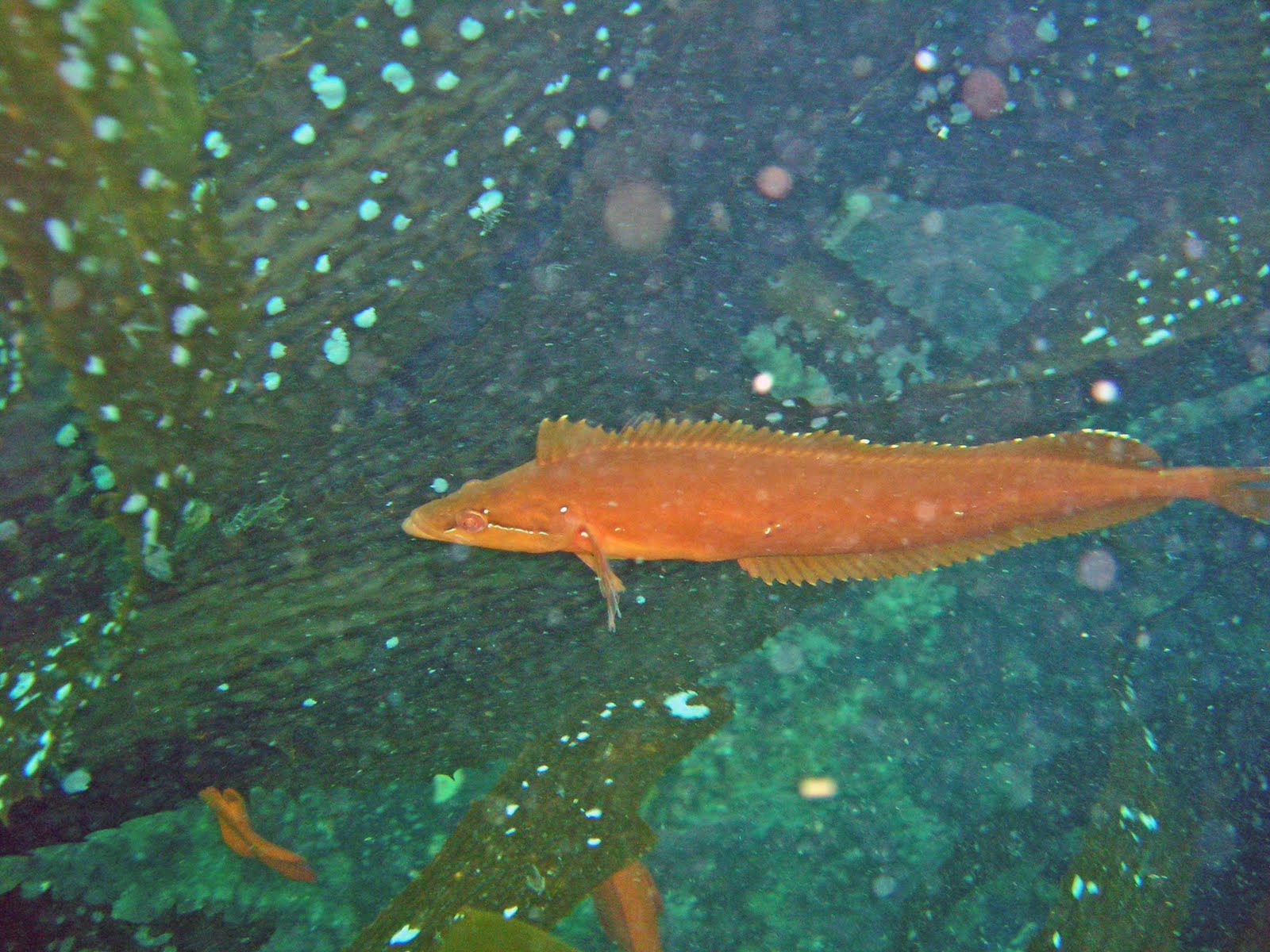
Giant Kelpfish

These look just like a blade of kelp and blend right in. They don't move much and you can swim right up to them and they just pretend to be kelp. This one was over a foot long. You can see how much suspended gunk was in the water in this photo.

Lightbulb Tunicates

The semitransparent tubes with the orange "filaments."

Giant Spined Star


Garibaldi


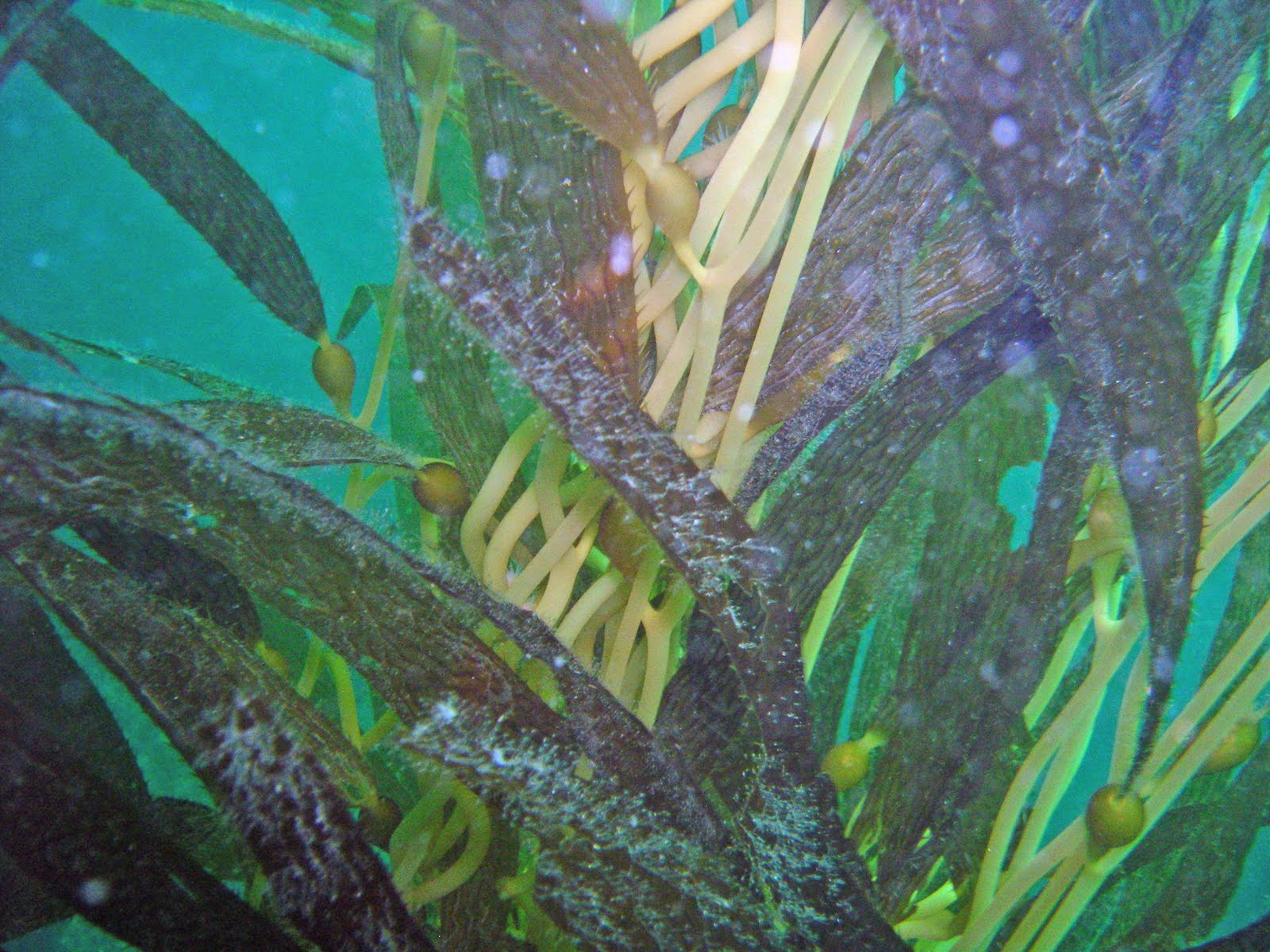
Macrocystis (Giant) Kelp

I tried to take photos of the kelp, but with the surge, lack of a strobe, and all the gunk in the water, they didn't turn out too well.

We swam on our compass heading until the first one reached 1800 psi and then turned and went back to the boat on a reciprocal heading. Even with all the surge, it worked great.

After a surface interval, George decided he was done for the day, so I took Dewey and Ken and struck off in the opposite direction for the second kelp dive.


Orange Puffball Sponge

About the size of a softball!

Red Seaweed (Plocamium cartilagineum)


Rock Scallop


California Spiny Lobster

Ummm! Scallops and Lobster! Dinner!

The kelp was thicker going north, but our swim out and the reciprocal back brought us right directly to the mooring line.

This shows a little of what it is like to swim through the kelp:


Today's dives were more relaxing and we didn't have the long surface boat ride to and from, so I am not nearly as tired at the end of the day as I was yesterday. That one about did me in.

Tuesday, June 15, 2010

June 15, 2010 Dives - Keyhole and Lobster Shack

On Tuesday, June 15, 2010, I dove with Dewey Olsen. Monday evening when the gear arrived, we gathered in the parking lot and Dewey was looking for a buddy. Pretty much everyone else was already buddied up, so I agreed to go with him. We did three dives at Los Coronados Islands - one on Keyhole, and two at Lobster Shack.

Will Rogers from the Tooele store was the leader of the group since Jay never made it. His mother-in-law is about to die, so he cancelled at the last minute. Will snapped a few photos as we were getting all the gear stowed and getting ready for the first day of diving.

The Humboldt

It took about an hour to run down to Los Coronados Islands. When we got ready to get in the water, Dewey found a problem with his gear about the same time we were getting in. Unfortunately, he didn't tell me before I got in, so I hung out on the surface while he fixed it. As it turned out, I don't think he rinsed or did any kind of maintenance on his gear since the last time he used it, so it was a wonder any of it worked.

When he finally got in (luckily the new wetsuit provided good protection hanging out on the surface), we descended and started out in a northerly direction along the "wall". Visibility was pretty good - perhaps 40 feet. The water was cold but not frigid, so I was relatively comfortable. Not tropical diving, but good.

The flora and fauna was way different. Seaweeds everywhere and lots of new things to see!

Bat Star

Not much coral here though, just the occasional gorgonian.

California Golden Gorgonian


Purple Sea Urchin


Garibaldi (juvenile)

I have only seen one sea hare in Hawaii. It was small, about tennis ball size. This one was huge - way over a foot long!
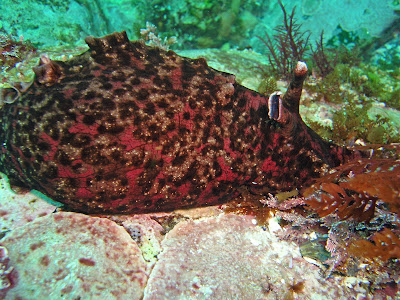
California Sea Hare

This is the largest scorpionfish I have ever seen. Probably 16 inches long. As far as I know, Dewey and I are the only ones to have seen it.

California Scorpionfish

Dewey may not have been diving in a long while (5 years), but he was pretty good on air consumption and we ended the dive when he had 500 psi. I still have 700. There was about 10 degrees difference from the bottom to the surface, so it felt pretty good ascending. Just before we got to the surface, a school of Pacific Sardines swam over us.

Pacific Sardines

During our surface interval, we travelled just around the corner to the north. In fact the boat just idled and it wasn't completely apparent we had moved, but there were a bunch of California Sea Lions lounging on the shore.

One was an enormous bull that was very belligerent. He was making a lot of noise and suddenly after this photo, he heaved himself up the ledge to the top, grabbed the female by the head and flung her off the ledge into the water! I was too dumbfounded to photograph it.
California Sea Lions


California Sea Lions

The boat provided hot soup and rolls between the first and second dives. That was perfect to warm up and get ready for the next dive.

When the surface interval was over and we were ready to get back in the water, Dewey was just starting a cup of coffee - well, not exactly coffee. He combined coffee, tea and cocoa into a single cup and had added some kind of seeds, I think flax seed. He had to quickly down that and then had trouble with his mask. The strap broke, so, once again, I was waiting around while fully geared up.

When we finally got in, we did much of the same as on the last dive. There were lots of new things that I had never seen before so I took lots of photos.

Zebra Goby


Solitary Green Anemone


Blue-Banded Goby

I occasionally see these in Hawaii, but they are larger and much less spooky here.

Christmas Tree Worms

In all the dives I have done, I have only seen two cowries with their mantles out. This one was right out in the open during the day.

Chestnut Cowry

These are huge - about 8 inches long.
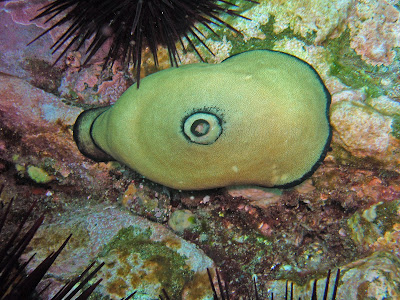
Giant Keyhole Limpet

This is where one of my favorite seafoods come from. Too bad the scallop is just the muscle that holds the shell to the body. That seems like a waste.

Rock Scallop & Purple Sea Urchins

There weren't whole rafts of kelp here, but there was enough to make this a really cool site. It was fun to swim between stands of it.

Feather Boa Kelp

I got cold at about 1100 psi and we ended the dive. I think Dewey would have stayed until he ran out of air, but we were about the only ones still in the water and I was frozen!

After some more hot soup and hot chocolate and some salad, I finally got warmed up during the surface interval. We stayed right at the same site.

After Dewey's next equipment problem we got back in the water for the third dive.

This time we went south from the boat and spent more time in the shallows. The water was warmer and there was lots of cool things to see.

Sea Hare Eggs


California Sheephead Wrasse (female)


Garibaldi

There were lots of these. I kept seeing them and taking photos because they look a lot like soft corals. It turns out that they are a species of sea cucumber.

Fisher's Sea Cucumber (Cucumaria salma)

I think we are the only ones who spotted an octopus today. He was hiding in this crack in the rock. I got one photo before Dewey began tearing rocks and everything else out of the way to expose him. He didn't like it much and was changing colors as you can see with these two photos. Dewey is not too environmentally conscious.


Two-Spot Octopus


Crowned and Red Sea Urchins

This video shows a little bit of what it is like in the kelp at Lobster Shack with surge flowing back and forth:


With about 1000 psi left, the cold once again drove us out of the water. Even at that, we were one of the last teams on the boat.